

Can swimming build muscles? Absolutely, and it’s one of the most efficient ways to develop a lean, toned physique. Swimming isn’t just a cardio workout; it’s a full-body resistance exercise that challenges every major muscle group.
Each stroke you take in the water strengthens your arms, chest, core, and legs while improving endurance and flexibility. Whether you’re aiming to tone up, build strength, or simply stay fit without lifting heavy weights, swimming offers a low-impact yet highly effective way to sculpt your body and boost overall fitness.
Does Swimming Everyday Build Muscles?

Swimming every day can absolutely help you build muscle, improve strength, and boost endurance, but like any form of exercise, balance and proper recovery are key. Each time you swim, your body works against the natural resistance of water, engaging almost every major muscle group.
Your shoulders, arms, back, chest, core, and legs are all activated as you propel yourself forward, making swimming one of the most complete and effective low-impact workouts available.
Daily swimming strengthens muscles gradually through consistent resistance. Because water is denser than air, even gentle strokes challenge your muscles, improving tone and definition over time.
Regular sessions also enhance cardiovascular fitness and stamina, meaning your body learns to perform longer, more efficiently, and with less fatigue. Many adults find that swimming daily helps them maintain a healthy weight, improve posture, and feel energised throughout the day.
However, swimming every single day without variation or rest can lead to fatigue or overuse injuries, especially in the shoulders and upper back.
Muscles need time to recover and rebuild to grow stronger. Incorporating lighter swim days, technique-focused sessions, or rest days allows your body to adapt and prevents burnout. If you feel sore or notice reduced performance, it’s a sign your muscles are asking for a short break.
For beginners or those returning to exercise, starting with three to five sessions per week is ideal. As your stamina improves, you can increase frequency and intensity safely. Mixing up your strokes, such as freestyle one day and breaststroke the next, helps work different muscle groups and keeps training enjoyable.
If you’re unsure how to structure your routine or want to learn proper technique to avoid strain, JustSwim Singapore offers private swimming lessons for adults and children.
Their experienced coaches focus on correct form, efficient breathing, and progressive training plans so you can strengthen muscles safely and effectively. With guidance from the right coach, you’ll see faster results and gain confidence in the water while enjoying a fun, sustainable path to fitness.
How Does Swimming Build Leg, Chest, And Upper Body Muscle?

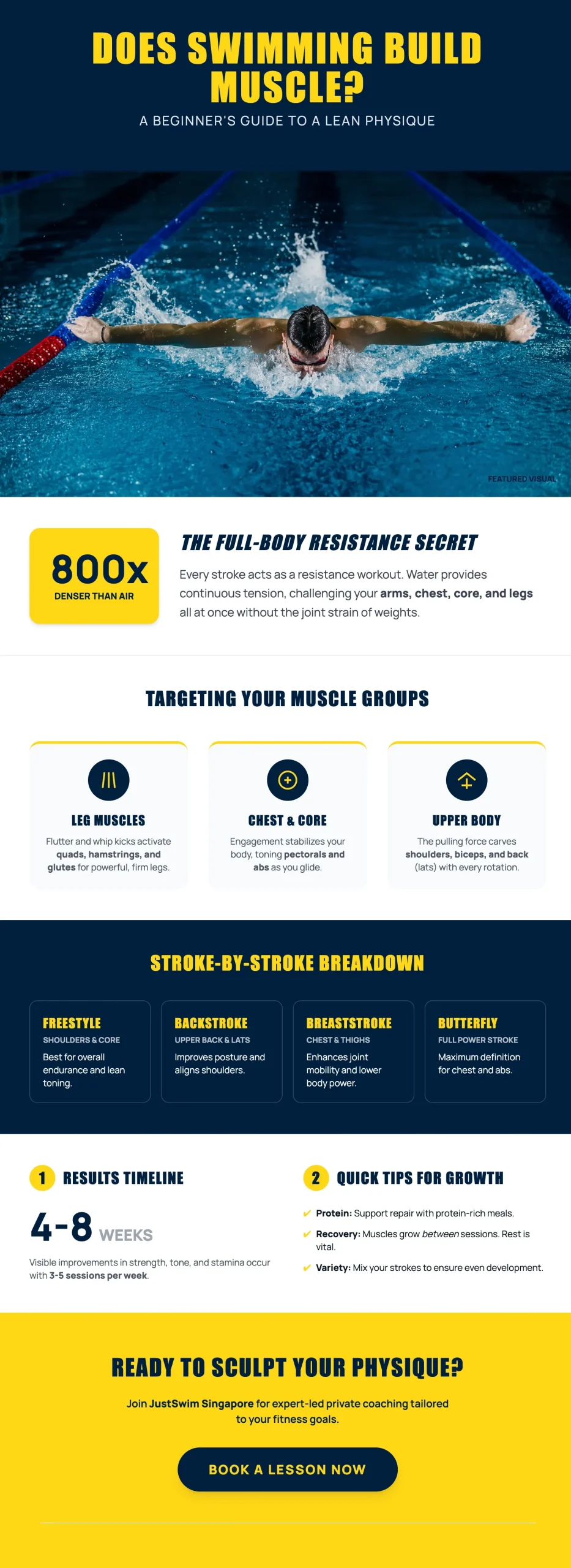
Swimming is one of the few exercises that engages nearly every major muscle group in your body, all at once. Each stroke you take in the pool challenges your muscles to work against water resistance, a force up to 800 times denser than air.
This constant push-and-pull motion strengthens, tones, and lengthens your muscles without the strain often caused by high-impact workouts. Over time, consistent swimming helps you develop firm legs, a strong chest, and a well-defined upper body, all while keeping your joints safe and supported.
Building Leg Muscles
Every kick you make in the pool is a mini resistance workout for your lower body. The flutter kick in freestyle and backstroke, or the whip kick in breaststroke, activates your quadriceps, hamstrings, calves, and glutes in one smooth motion.
Because your legs must constantly push against the water’s drag, you’re strengthening and toning them without the pounding impact that comes from running or jumping.
Swimming also enhances lower body endurance and flexibility. For example, breaststroke kicks improve hip mobility, while flutter kicks help stabilise your core and lower back.
Over time, swimmers develop lean, firm, and powerful legs that support better balance, coordination, and overall strength, all without joint pain or stiffness. It’s one of the reasons swimming is so popular among adults looking to stay fit and mobile at any age.
Strengthening The Chest And Core

Your chest and core play a vital role in keeping your body stable and streamlined in the water. Strokes like freestyle and butterfly heavily engage the pectoral muscles, helping to expand your chest and build strength across the upper torso.
Each arm pull works your chest and shoulders, while your abs and obliques stabilise the body, maintaining alignment as you glide through the water.
Water resistance provides continuous tension, forcing your muscles to stay engaged throughout the entire stroke. This is particularly effective for toning the abdominal area, improving posture, and reducing back strain.
Over time, consistent swimming leads to a stronger, more sculpted chest and a tighter, more defined midsection, without the need for crunches or heavy lifting. Plus, the rhythmic breathing pattern in swimming strengthens your diaphragm, contributing to better endurance and overall body control.
Building The Upper Body And Back
Your upper body and back are the driving forces behind every stroke. Each pull through the water strengthens the shoulders, biceps, triceps, and the muscles of the upper and middle back, such as the latissimus dorsi and trapezius.
These muscles work together to provide propulsion, power, and balance, helping you move efficiently and gracefully through the pool.
Regular swimming can noticeably improve shoulder definition and posture. The pulling and rotation involved in strokes like freestyle and backstroke train your back muscles to stabilise the spine and keep your shoulders aligned.
This not only enhances your physique but also prevents common postural issues caused by desk jobs or sedentary lifestyles. Over time, swimming sculpts your arms, chest, and back into a balanced, lean, and powerful frame.
How Fast Does Swimming Build Muscle?

Building muscle through swimming doesn’t happen overnight, but with consistency and proper technique, results can appear sooner than you might expect. Most adults begin to notice improvements in strength, tone, and endurance within four to eight weeks of regular swimming.
However, the exact timeline depends on several factors, such as workout frequency, intensity, diet, and your current fitness level.
The key is consistency and progression: swimming at a steady pace is good, but pushing yourself with varied strokes and resistance challenges your muscles to adapt and grow stronger over time.
Swimming works differently from traditional weight training because it focuses on lean muscle development rather than bulky gains. The water’s natural resistance creates a continuous, low-impact workout that tones muscles gradually.
As you swim, your body is constantly adjusting to stay buoyant and streamlined, this stabilising action strengthens the smaller, supportive muscles often overlooked in gym routines. Over time, this leads to a more athletic, defined shape with better posture and coordination.
If you swim three to five times a week, you’ll likely see visible toning within a month, along with improved stamina and flexibility. Those who incorporate different strokes, like freestyle for upper body strength and breaststroke for leg power, tend to see faster, more balanced results.
You can accelerate progress by adding swimming drills, using resistance tools like paddles or fins, or doing short sprint sets to challenge your muscles further.
Rest and recovery also play a vital role in muscle development. Your muscles repair and grow stronger between sessions, not during them.
Taking one or two rest days a week or alternating light and intense swim sessions helps prevent overtraining and ensures consistent progress. Combine this with proper nutrition, especially protein-rich meals, to support muscle repair and energy replenishment.
For those new to swimming or unsure how to structure their workouts, JustSwim Singapore offers customised swimming lessons designed to help adults and children train effectively and safely.
Their coaches understand how to balance technique, endurance, and resistance training to maximise results without causing strain. With expert guidance, you can expect visible muscle tone, better control in the water, and a stronger, leaner physique that lasts.
5 Stroke-By-Stroke Muscle Breakdown

Every swimming stroke engages a different combination of muscles, giving you a varied and complete workout each time you get in the pool. By understanding how each stroke targets specific muscle groups, you can train more effectively and build a balanced, powerful physique.
From improving endurance to toning your back and core, every stroke contributes to sculpting a stronger, leaner body. Let’s take a closer look at how each one works, starting with freestyle and backstroke, two of the most popular and beneficial techniques.
1. Freestyle (Front Crawl)
Freestyle is the go-to stroke for building endurance and overall body strength. As you pull yourself through the water, your shoulders, biceps, triceps, and forearms engage in a continuous cycle of motion.
This repetitive pulling action strengthens and tones your upper arms and shoulders, while the alternating kicks activate your quadriceps, hamstrings, and glutes, adding lower body power.
Your core plays a central role in freestyle swimming. Every rotation of your torso engages your abs and obliques, helping you stay balanced and streamlined in the water. This constant core engagement not only tones your midsection but also improves stability and posture on land.
The combination of upper and lower body movement makes freestyle one of the best strokes for all-round muscle development, endurance, and cardiovascular health.
For those aiming to refine their technique and build muscle safely, professional guidance makes a huge difference.
JustSwim Singapore provides children swimming lessons and adult swimming lessons as well, focusing on efficient stroke mechanics, proper breathing, and controlled movements, helping you maximise muscle gains while preventing fatigue or strain.
2. Backstroke
Backstroke is an excellent stroke for improving posture, strengthening the back muscles, and developing upper body endurance. It primarily targets the latissimus dorsi, deltoids, and shoulder stabilisers, creating a strong and defined upper back.
The alternating arm motion builds balanced strength on both sides of the body, while the continuous flutter kick tones the legs and glutes without putting stress on the knees or hips.
Because you’re swimming on your back, this stroke naturally opens up the chest and stretches the shoulders, counteracting the forward-hunched posture many adults develop from sitting at desks or using devices.
It’s also easier on the neck and spine, making it a fantastic option for swimmers seeking a low-impact, muscle-strengthening workout.
Core engagement is key in maintaining stability during backstroke. Your abs and obliques help keep your body aligned as you glide across the water, preventing the hips from sinking.
Over time, consistent backstroke practice enhances your posture, strengthens your spine-supporting muscles, and gives your upper body a sleek, toned appearance.
3. Breaststroke

The breaststroke is one of the most controlled and technique-driven strokes in swimming, known for its signature frog-like kick and graceful rhythm.
Each kick engages the inner thighs, glutes, and hamstrings, while the sweeping arm motion strengthens the chest, shoulders, and triceps. This combination creates a smooth, flowing movement that builds both power and flexibility.
Because the stroke requires perfect timing between the arm pull and leg kick, it also strengthens your core muscles, which stabilise your body and maintain alignment through the water.
The breaststroke’s deliberate pace and symmetrical movement promote muscular balance and joint mobility, making it an ideal choice for those looking to tone their lower body while improving flexibility. It’s particularly beneficial for adults who prefer a steady, low-impact swim that still delivers noticeable strength gains.
Practising with proper form is essential, as incorrect timing can reduce efficiency and cause strain. At JustSwim Singapore, swimming coaches focus on refining your technique, ensuring every glide, pull, and kick works harmoniously to maximise your strength, endurance, and enjoyment in the pool.
4. Butterfly
The butterfly stroke is often called the “power stroke”, and for good reason. It’s one of the most demanding and effective full-body workouts in swimming, combining strength, rhythm, and explosive energy.
Every stroke activates the chest, shoulders, arms, and upper back, while the powerful dolphin kick engages the core, hips, and legs, providing a complete strength-building routine.
The simultaneous arm pull and fluid undulating motion of the body require both power and coordination. This stroke improves upper body endurance, builds a broader back, and enhances lung capacity due to its intense breathing pattern.
Over time, butterfly training leads to visible definition across the chest, arms, and abs, creating that athletic “swimmer’s physique” many aspire to achieve.
5. Sidestroke
The sidestroke is one of the gentlest yet most efficient strokes, perfect for active recovery or relaxed endurance sessions. It’s often used by lifeguards for its stability and control, but it also offers excellent muscle-toning benefits.
The scissor kick targets the inner and outer thighs, glutes, and core, while the alternating arm pulls tone the shoulders and arms without excessive strain.
This stroke allows you to maintain steady movement with minimal effort, promoting flexibility and endurance while keeping your body aligned.
It’s especially useful for adults who want to stay active on lighter days or are easing into swimming as part of a fitness routine. Despite its slower pace, sidestroke keeps your muscles engaged and your heart rate up, making it a surprisingly effective way to tone your body gently.
Conclusion About Swimming Build Muscles
Swimming isn’t just about gliding across the water, it’s about building a lean, strong, and resilient physique through consistency and smart training. Every stroke works your muscles, challenges your endurance, and refines your coordination.
Over time, you’ll notice your body becoming not just fitter, but also more balanced and powerful, without the strain of heavy weights or high-impact workouts.
If you’re ready to take the plunge and experience these benefits yourself, consider joining JustSwim Singapore.
Established in 2020 by a team of passionate coaches, including competitive swimmers, triathletes, and lifesavers, JustSwim Singapore specialises in private swimming lessons for both adults and children.
We personalised, small-group approach ensures you or your child can learn effectively, stay focused, and progress confidently.
With patient, experienced coaches who prioritise water safety, enjoyment, and steady improvement, JustSwim Singapore guarantees that every swimmer, regardless of age or experience, can master the right techniques and swim with confidence.
So, whether you’re looking to build muscle, improve fitness, or simply fall in love with swimming, dive into your journey with JustSwim Singapore today, where progress, safety, and fun flow together.
Frequently Asked Questions About Swimming Build Muscles
Does Swimming Build Muscle Evenly Across The Body?
Yes, swimming helps develop muscles evenly because every stroke engages multiple muscle groups simultaneously. Your shoulders, arms, back, core, and legs all work together to move you through the water. Over time, this creates balanced strength and a well-toned, symmetrical physique.
Are Swimming Workouts Effective For People Who Want To Lose Fat And Build Muscle?
Absolutely. Swimming burns calories efficiently while also strengthening and toning muscles through natural water resistance. It’s an excellent option for people seeking fat loss and lean muscle growth without high-impact strain on the joints.
Is Swimming Enough To Build Muscle Without Any Other Exercise?
Swimming alone can improve muscle tone, endurance, and overall strength, especially for beginners. However, it may not provide enough resistance for significant muscle hypertrophy. Combining swimming with resistance or bodyweight training produces faster, more visible muscle gains.
Can Swimming Build Muscle At Any Age?
Yes, swimming can build muscle at any age because it’s low-impact and adaptable to all fitness levels. The water supports your body weight, reducing stress on joints while still providing strong resistance. It’s ideal for both young learners and older adults looking to maintain muscle strength and flexibility.
Where Do Swimmers Build The Most Muscle From Training?
Swimmers tend to develop the most muscle in their shoulders, arms, chest, and back due to repeated pulling motions. The constant kicking also tones the legs and glutes, creating full-body definition. This balanced effort across strokes leads to lean, athletic muscle development.
When Is The Best Time To Swim For Muscle Gain?
The best time to swim for muscle gain is when your energy levels are highest, typically in the morning or early evening. Consistency matters more than timing, so choose a schedule you can maintain long term. Focus on intensity, proper form, and recovery to maximise muscle growth.


