

The terms individual medley vs medley relay are often confused because both swimming events use the same four strokes—butterfly, backstroke, breaststroke, and freestyle. Despite this similarity, they are raced in very different ways.
An individual medley is a solo event where one swimmer completes all four strokes in a specific order, while a medley relay is a team race with each swimmer responsible for just one stroke.
In this guide, you’ll learn the clear differences between individual medley vs medley relay, including how each race is structured, the stroke order, key rules, and how results are scored.
Individual Medley Vs. Medley Relay

In swimming, the individual medley and the medley relay are often grouped together because both races include the same four competitive strokes: butterfly, backstroke, breaststroke, and freestyle. The similarity ends there. The key difference lies in how the race is structured and how those strokes are swum.
Understanding this distinction makes it much easier to follow races, learn the rules, and appreciate the skills required in each event.
What Is An Individual Medley (IM)?
An individual medley (IM) is a race completed by one swimmer, who must swim all four strokes in a fixed order during a single event.
The standard stroke sequence for an IM is butterfly first, followed by backstroke, then breaststroke, and finally freestyle. This order is set by swimming regulations and must be followed exactly to avoid disqualification.
The main challenge of the individual medley is managing four different techniques, rhythms, and breathing patterns in one continuous swim.
Each stroke uses different muscle groups and requires its own timing, which means swimmers must be well-rounded and technically sound. In addition, the transitions between strokes—especially from backstroke to breaststroke—demand precise coordination and strong awareness of the rules.
For adults learning to swim or parents supporting their children’s progress, the individual medley highlights the importance of balanced stroke development. It rewards swimmers who are not only fast but also efficient, adaptable, and confident in the water across all strokes.
What Is A Medley Relay?
A medley relay is a team event involving four swimmers, with each swimmer responsible for one stroke over an equal portion of the race distance.
Unlike the individual medley, the stroke order in a medley relay is backstroke first, then breaststroke, followed by butterfly, and freestyle last. This order allows the backstroke swimmer to start properly in the water, which would not be possible mid-race.
In a medley relay, each swimmer focuses on performing one stroke at their best, making the event ideal for stroke specialists. However, speed alone is not enough. Relay races introduce an additional layer of complexity through exchanges, also known as takeovers.
Each swimmer must time their start so that they leave the block only after the incoming swimmer touches the wall. Poorly timed exchanges can slow the team down or result in disqualification.
For adults and children alike, the medley relay demonstrates the value of teamwork, communication, and trust. Every swimmer’s performance directly affects the final result, making it an exciting and dynamic race that combines individual skill with collective effort.
6 Differences Between Individual Medley And Medley Relay In Swimming

Although the individual medley and medley relay share the same four strokes, they are raced under very different conditions.
These differences affect how swimmers train, how races are run, and how results are decided. Understanding them is especially useful for adults learning to swim or parents supporting children in lessons, as it explains why certain skills are emphasised in different settings.
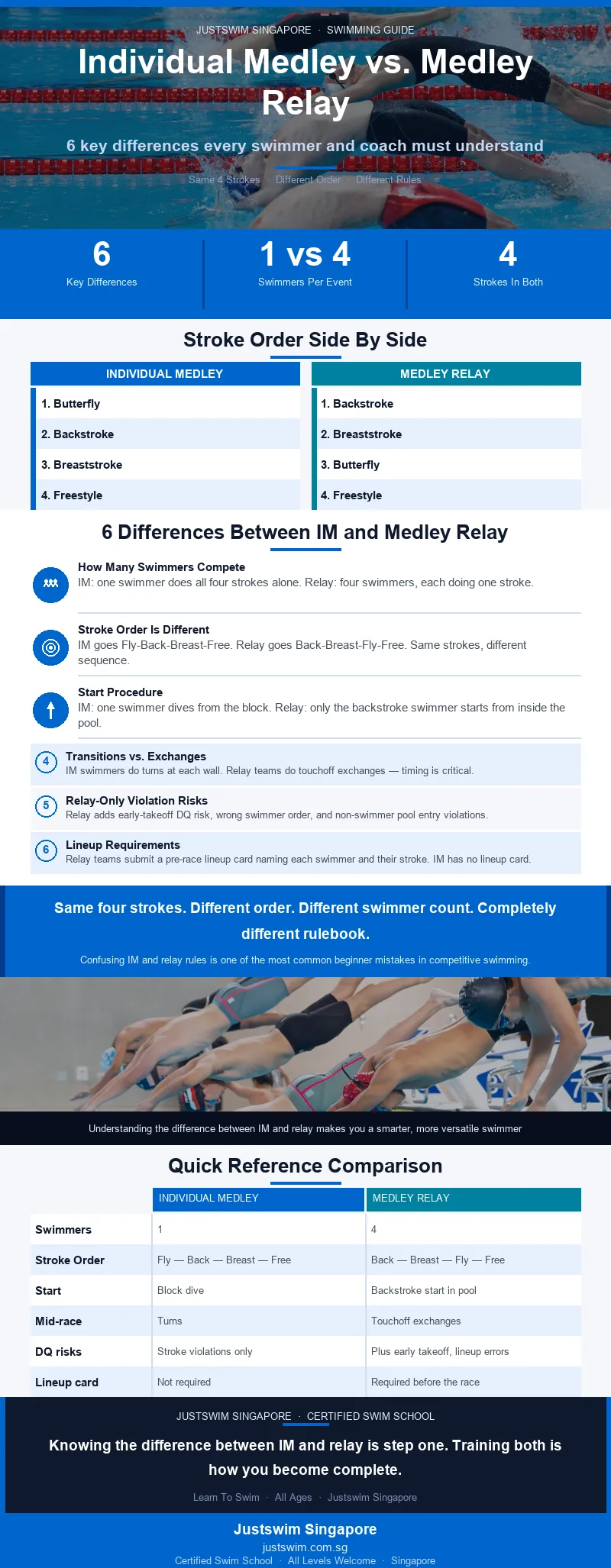
1. How Many Swimmers Compete
The most obvious difference between an individual medley and a medley relay is the number of swimmers involved. In an individual medley, a single swimmer is responsible for completing the entire race from start to finish.
This means one person must manage all four strokes, maintain endurance, and follow every technical rule throughout the swim. There is no support from teammates during the race, so consistency and personal pacing are essential.
In a medley relay, the race is shared by four swimmers, each assigned to one stroke. Every swimmer contributes a quarter of the total distance, and the team’s final result depends on how well all four performances come together.
This shifts the responsibility from individual endurance to team coordination and trust. A strong relay requires not only fast swimmers but also clear communication and reliable exchanges.
2. Stroke Order Is Different
Stroke order is one of the most commonly misunderstood differences. In an individual medley, the swimmer must follow the fixed sequence of butterfly, backstroke, breaststroke, then freestyle. This order is designed around technical rules and how strokes transition from one to the next during a continuous swim.
In a medley relay, the order changes to backstroke, breaststroke, butterfly, and freestyle. The reason for this is practical: backstroke must begin in the water, so it has to be the first leg of the relay. The remaining strokes then follow in a logical sequence that allows clean exchanges.
Mixing up these two orders is a frequent cause of confusion, especially for beginners. In competitive swimming, swimming the correct strokes in the wrong order can lead to disqualification.
Learning the difference early helps swimmers and parents avoid unnecessary mistakes and builds confidence during lessons and races.
3. Start Procedure

The start of the race also differs significantly between the two formats. In an individual medley, the swimmer begins with a standard forward dive start, similar to freestyle or butterfly races. After that single start, the swimmer continues through all four strokes without leaving the water.
A medley relay follows a different process. The first swimmer, who swims backstroke, starts in the water, holding the wall and reacting to the starting signal.
The remaining three swimmers start from the blocks using relay exchanges. Each outgoing swimmer must time their take-off carefully, ensuring the incoming swimmer touches the wall first.
These relay-specific procedures add excitement but also increase pressure. Good starts and clean exchanges can gain valuable time, while poor timing can cost the team the race.
For learners, understanding these start differences helps explain why relay races look and feel very different from individual events.
4. Transitions Vs. Exchanges
One key difference between the individual medley and the medley relay lies in how swimmers move from one part of the race to the next. In an individual medley, the swimmer must perform three in-race transitions as they change strokes.
These transitions happen without stopping and must follow strict technical rules. For example, when moving from backstroke to breaststroke, the swimmer needs to touch the wall while on their back before turning and pushing off correctly for breaststroke.
Each transition requires good timing, body awareness, and a solid understanding of stroke rules.
In a medley relay, there are no stroke-to-stroke transitions for a single swimmer. Instead, the focus is on exchanges, where one swimmer finishes their leg and the next swimmer takes over. These exchanges are all about coordination and timing.
The outgoing swimmer must react quickly but cannot leave the starting block until the incoming swimmer has touched the wall. Clean exchanges can save valuable time, while poorly timed ones can cost the team seconds or even lead to disqualification.
5. Relay-Only Timing/Violation Risks
Medley relays introduce several rules and risks that simply do not exist in individual medley races. One of the most common issues is an early take-off, where the outgoing swimmer leaves the block before the incoming swimmer finishes their leg. Even a fraction of a second too early can result in the entire team being disqualified.
Other relay-specific mistakes include swimmers interfering with teammates in the water, entering the pool too early, or failing to follow correct finishing rules for their stroke before the exchange. Because four swimmers are involved, the chances of small errors increase.
This makes relay races exciting but also demanding, as every swimmer must stay focused on both their own swim and the timing of the exchange.
6. Lineup Requirements
In an individual medley, there is no need for a lineup. One swimmer completes the entire race, so preparation focuses on stroke balance, endurance, and smooth transitions. All responsibility rests on the individual in the water.
A medley relay, however, requires careful lineup planning. Coaches must decide which swimmer is best suited for each leg: backstroke, breaststroke, butterfly, or freestyle.
This decision is based on stroke strength, consistency, and how well a swimmer performs under pressure during exchanges. The order of swimmers can have a big impact on the overall result, especially when races are closely contested.
Lineup strategy also teaches valuable lessons about teamwork and role awareness. Each swimmer has a specific job to do, and success depends on everyone delivering their part.
This team-based approach is one of the biggest differences between the medley relay and the individual medley, and it helps swimmers develop confidence both independently and as part of a group.
How Results Are Measured For Individual Medley And Medley Relay?

In swimming competitions, results are measured differently for the individual medley and the medley relay, reflecting the unique nature of each event. Understanding how timing and results work can help adults and parents better follow races and appreciate what swimmers are aiming to achieve.
In an individual medley, the outcome is straightforward. The swimmer’s final time is recorded from the starting signal to the moment they touch the wall at the finish of the freestyle leg. This single time determines the swimmer’s placing in the race.
While split times for each stroke may be recorded for analysis or coaching purposes, only the overall finishing time counts towards the official result. This makes the individual medley a clear test of one swimmer’s ability to manage all four strokes efficiently across the full distance.
In a medley relay, results are based on the combined performance of the entire team. The official race time runs continuously from the start of the backstroke leg until the final freestyle swimmer touches the wall.
Each swimmer’s leg contributes to the total time, but just as important are the relay exchanges between swimmers. Even if all four swimmers are fast, poorly timed or illegal exchanges can slow the team down or lead to disqualification.
Split times are often tracked in medley relays to show how each swimmer performed in their stroke, which helps coaches and swimmers review strengths and areas for improvement. However, these splits do not affect the final placing on their own.
What matters most is the team’s total time with legal exchanges, highlighting why teamwork and coordination are just as critical as individual speed in relay events.
Conclusion About Individual Medley Vs. Medley Relay
Understanding individual medley vs medley relay is much simpler once you focus on the core idea behind each event. An individual medley is a solo race where one swimmer completes all four strokes in a fixed order, testing overall versatility and endurance.
A medley relay, on the other hand, is a team event where four swimmers each specialise in one stroke, making teamwork, exchanges, and coordination just as important as speed.
Although both formats use the same strokes, their structure, rules, and scoring are fundamentally different, which is why they are treated as separate events in competitive swimming.
For adults looking to learn swimming or parents exploring lessons for their children, understanding these basics highlights the importance of strong technique across all strokes. This is where JustSwim Singapore can support your journey.
Established in 2020 during Covid-19 by a group of dedicated coaches from diverse swimming backgrounds—including competitive swimmers, triathletes, and lifesavers—JustSwim Singapore focuses on private swimming lessons to maximise attention, focus, and progress.
Our patient and experienced coaches are committed to delivering high-quality instruction in water safety, skill progression, and enjoyment, without compromising affordability.
Using a unique teaching approach developed through years of experience in major swim schools across Singapore, our lessons are engaging, effective, and tailored to each individual. From infants and toddlers to adults and retirees, every lesson plan is customised to suit personal goals and abilities.
If you are ready to build confidence in the water or help your child develop strong swimming fundamentals, contact JustSwim Singapore today to find out more about our swimming lessons.
Frequently Asked Questions About Individual Medley Vs. Medley Relay
Is Individual Medley Harder Than Swimming A Medley Relay Leg?
Individual medley is generally more demanding because one swimmer must maintain technique and endurance across all four strokes, while relay swimmers focus on a single stroke at maximum effort.
Can Beginners Take Part In Individual Medley Or Medley Relay Races?
Beginners can be introduced to both formats at entry levels, but individual medley usually requires more foundational skills since swimmers must be comfortable with all four strokes.
Are Individual Medley And Medley Relay Swum Over The Same Distances?
No. Individual medley races are commonly offered as 100m, 200m, or 400m events, while medley relays are typically raced as 4x50m or 4x100m formats.
Is Learning Individual Medley Useful For Long-Term Swimming Development?
Yes, training for individual medley helps swimmers develop balanced technique, coordination, and endurance, which also improves performance in relay events and general swimming ability.
How Do Coaches Decide Who Swims Each Leg Of A Medley Relay?
Coaches assign relay legs based on stroke strength, consistency under pressure, and how well swimmers can perform fast, legal exchanges.


