

Swimming is more than just a fun way to cool off, it’s also one of the most effective full-body workouts you can do. If you’ve ever wondered, “does swimming burn a lot of calories?”, the answer is a definite yes.
Swimming engages nearly every major muscle group while providing a low-impact cardiovascular workout, making it ideal for anyone looking to lose weight or stay fit.
Understanding how swimming burns calories helps you tailor your workouts for better results. In this guide, we’ll break down how different strokes, intensity levels, and swim durations affect your overall calorie burn.
Does Swimming Burn A Lot Of Calories?

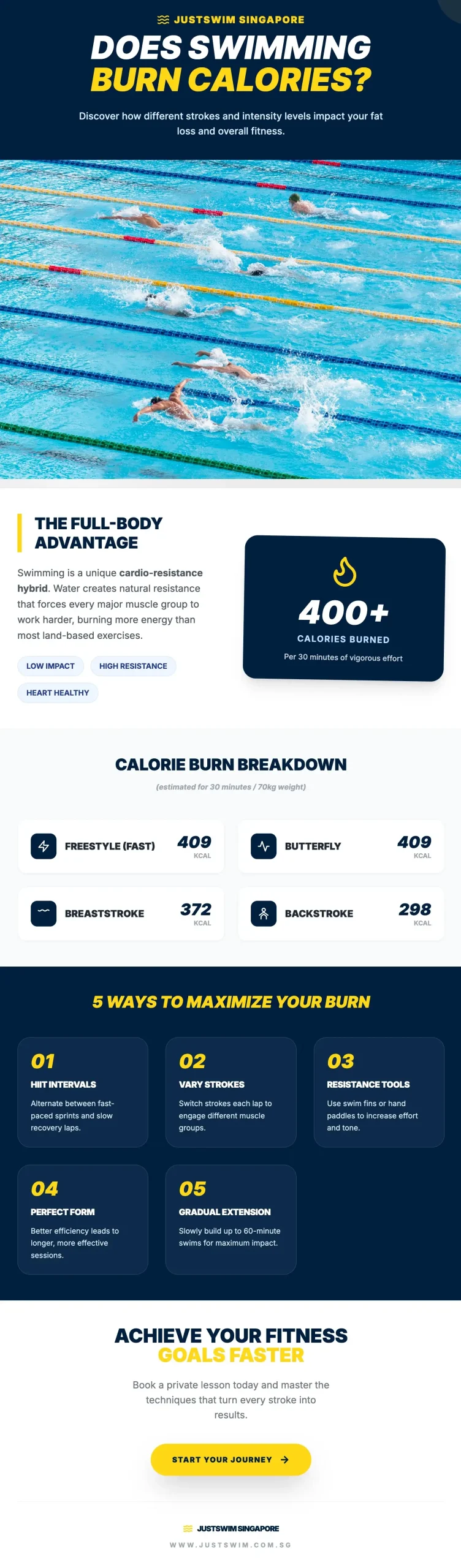
Swimming is one of the most effective ways to burn calories and improve overall fitness because it works the entire body at once. Every stroke you take engages multiple muscle groups, from your arms, shoulders, and back to your core, glutes, and legs.
Unlike exercises such as running or cycling, which focus on specific muscle areas, swimming combines cardiovascular endurance with resistance training.
The water creates natural resistance, meaning your muscles must work harder to push and pull through each movement, resulting in a higher calorie expenditure even at a moderate pace.
Beyond calorie burning, swimming strengthens the heart and lungs, enhances flexibility, and promotes lean muscle growth. It’s a total-body workout that improves both endurance and strength without putting stress on the joints. This makes it an ideal exercise for those looking to lose weight, maintain fitness, or simply stay active in a sustainable way.
For adults who may feel unsure about starting or refining their technique, professional coaching can make a big difference. Learning proper form helps you swim more efficiently, and in turn, burn more calories per session.
If you’re interested in improving your stroke and maximising the benefits of swimming, JustSwim Singapore offers private swimming lessons for both adults and children. With experienced coaches and a supportive approach, you’ll gain confidence in the water while achieving your fitness goals faster.
How Many Calories Does Swimming Burn? (By Stroke, Weight & Duration)

The number of calories burned during swimming can vary greatly from person to person, and that’s what makes it such a flexible form of exercise. The main factors influencing calorie burn include the swimming stroke, your body weight, workout intensity, and how long you swim.
Each of these elements plays a unique role in determining how efficiently your body uses energy in the water.
Understanding How Swimming Burns Calories
Swimming is a unique exercise because of how it challenges the body in multiple ways at once. When you move through water, your body must constantly overcome resistance, much greater than what you’d experience in air.
This resistance activates a wide range of muscles simultaneously, from your shoulders and arms to your core and legs. As a result, your body works harder to maintain balance, stability, and forward motion, which significantly boosts calorie burn.
At the same time, water provides buoyancy, which supports your body weight and reduces impact on your joints. This means you can perform high-effort movements without straining your knees, hips, or back, a key advantage for adults who want to exercise safely and effectively.
Despite being low-impact, swimming still raises your heart rate, increasing oxygen demand and energy use, just like other intense cardio activities.
Another factor that contributes to calorie burning is continuous movement. Because there’s rarely a pause in swimming, your body is always in motion, you maintain a steady level of exertion.
The combination of resistance, muscle engagement, and sustained activity keeps your metabolism elevated both during and after your swim, helping you burn more calories overall.
Estimated Calories Burned by Stroke and Weight (per 30 Minutes)

Each swimming stroke engages your muscles differently, resulting in varied levels of calorie burn. Faster, more demanding strokes such as freestyle and butterfly typically burn the most calories because they require continuous, powerful movements and engage nearly all major muscle groups.
In contrast, strokes like breaststroke and backstroke burn slightly fewer calories but are excellent for building endurance and improving technique.
Your body weight also plays a significant role in determining how many calories you burn during a swim. Heavier individuals naturally expend more energy as they move through the water, while lighter swimmers burn slightly fewer calories under the same conditions.
The table below provides an estimated breakdown of calories burned per 30 minutes of swimming, based on different strokes and body weights. Use this as a guide to better understand how your swim sessions translate into energy expenditure.
| Swimming Stroke | 125 lbs (57 kg) | 155 lbs (70 kg) | 185 lbs (84 kg) |
| Freestyle (slow) | 180 calories | 223 calories | 266 calories |
| Freestyle (fast) | 330 calories | 409 calories | 488 calories |
| Breaststroke | 300 calories | 372 calories | 444 calories |
| Backstroke | 240 calories | 298 calories | 355 calories |
| Butterfly | 330 calories | 409 calories | 488 calories |
| Treading water (vigorous) | 300 calories | 372 calories | 444 calories |
These figures show that even moderate swimming can rival, or surpass, many land-based workouts in calorie burn. By switching between strokes and varying your pace, you can keep your workout both engaging and effective.
For adults learning to swim or refining their technique, expert guidance helps ensure proper form so every stroke counts. At JustSwim Singapore, our experienced coaches can design personalised sessions that maximise calorie burn while building your confidence in the water.
How Duration Affects Calorie Burn
The length of your swim session plays a major part in how many calories you burn overall. Because swimming is an endurance-based exercise, the longer you maintain movement and effort, the more energy your body uses.
A 30-minute session can burn anywhere from 200 to 450 calories, depending on your intensity, while doubling your time to 60 minutes can easily push your total burn beyond 600 to 900 calories.
However, it’s not just about time, consistency and pace matter too. Swimming continuously at a steady rhythm helps maintain a higher heart rate, which improves cardiovascular endurance and overall fat-burning efficiency.
High-intensity intervals, where you alternate between fast and recovery laps, can further boost calorie burn by challenging your muscles and metabolism.
Swimming vs Running: Which Burns More Calories?

Swimming and running are two of the most effective cardio workouts for improving fitness and burning calories, yet they differ significantly in how they engage the body.
Running primarily targets the lower body, working the legs, hips, and core, while swimming activates almost every major muscle group, including the arms, shoulders, chest, and back.
Because water provides continuous resistance, swimming functions as both a cardiovascular and strength-training exercise, helping to tone muscles while improving endurance.
In terms of calorie burn, the numbers can vary based on intensity and duration. A 70 kg (155 lbs) adult running at a moderate pace (6 mph or roughly 10 minutes per kilometre) burns around 372 calories in 30 minutes, while swimming vigorous freestyle burns around 409 calories in the same period.
This makes swimming slightly more efficient in calorie burn per session, with the added benefit of reduced joint stress due to buoyancy.
For those recovering from injury, managing joint pain, or seeking a low-impact yet effective full-body workout, swimming often provides a safer and more sustainable option than high-impact running.
Beyond calorie count, swimming also supports flexibility, lung capacity, and posture, areas that running doesn’t always target directly. Moreover, swimming helps prevent overheating, allowing you to sustain your effort longer without discomfort.
In short, both activities are excellent for burning calories and improving cardiovascular health, but swimming offers a unique blend of low-impact resistance training and total-body conditioning, making it ideal for adults of all ages and fitness levels.
How Cold Water Swimming Boosts Calorie Burn?

Swimming in cold water isn’t just refreshing, it can also increase the number of calories you burn. When you enter cooler temperatures, your body activates a process called thermogenesis, which means it works harder to maintain its core temperature.
This natural response causes your metabolism to increase, leading to higher energy expenditure compared to swimming in warmer water. Essentially, your body burns more calories not only through movement but also by generating heat to stay warm.
In addition to boosting calorie burn, cold-water swimming has been linked to improved circulation, stronger immunity, and a greater sense of alertness. The shock of cold water can stimulate endorphin release, giving you that uplifting “post-swim” feeling many swimmers describe.
However, it’s important to approach this type of swimming safely. Gradual exposure to cooler temperatures allows your body to adapt, and proper supervision or guidance is recommended for beginners.
Always avoid extremely cold conditions or swimming alone, especially if you’re not accustomed to open-water environments.
5 Ways On How To Maximise Calorie Burn While Swimming

Swimming is already a powerful full-body workout, but there are ways to make each session even more effective for burning calories and improving fitness. By adjusting your intensity, incorporating different strokes, and focusing on technique and endurance, you can significantly enhance your results in the pool.
These strategies are practical and suitable for swimmers of all levels, from beginners aiming to stay active to seasoned swimmers looking to fine-tune their performance.
Below are five proven methods to help you maximise your calorie burn while swimming and make every session more rewarding.
1. Alternate Between High-Intensity And Recovery Intervals
Incorporating interval training into your swim routine is one of the most effective ways to boost calorie burn. By alternating between fast-paced laps and slower recovery intervals, you challenge your cardiovascular system and increase your metabolic rate, both during and after your workout.
This approach, often referred to as High-Intensity Interval Training (HIIT), helps your body burn calories more efficiently while improving endurance and overall performance.
For instance, you might swim one or two laps at full effort, followed by a slow, easy lap to recover. Repeating this pattern for 20–30 minutes keeps your heart rate elevated and prevents your body from adapting to a single intensity level. The result is a workout that burns more calories in less time compared to maintaining a steady pace throughout.
Interval training also keeps your sessions engaging and mentally stimulating, helping you stay motivated. Beginners can start with shorter sprints and longer recovery times, while advanced swimmers can increase the duration or intensity of their fast laps.
2. Use Different Strokes To Engage More Muscles
Switching between various swim strokes is another excellent way to increase calorie burn and target a broader range of muscles. Each stroke, from freestyle and breaststroke to backstroke and butterfly, works your body differently, engaging distinct muscle groups and requiring varying levels of effort.
For example, freestyle and butterfly engage your shoulders, chest, and core more intensely, while breaststroke focuses on your legs, hips, and glutes.
By combining strokes within a single workout, you can avoid muscle fatigue while maintaining a higher overall intensity. This variety ensures that no single muscle group gets overworked and allows you to sustain your session for longer periods, leading to greater calorie expenditure.
Additionally, using multiple strokes improves balance, coordination, and flexibility, making your swimming technique more efficient and enjoyable.
3. Incorporate Resistance Tools

Adding resistance tools to your swimming routine is an excellent way to intensify your workouts and burn more calories.
Equipment such as swim fins, hand paddles, kickboards, and drag suits increase the effort required to move through the water, forcing your muscles to work harder against resistance. This not only boosts calorie burn but also helps develop greater strength, endurance, and stroke efficiency over time.
For example, using hand paddles increases the surface area of your hands, engaging your shoulders, chest, and back more effectively. Swim fins strengthen your legs and improve ankle flexibility, while drag suits or resistance parachutes add an extra challenge by slowing you down, making each movement more powerful.
These tools are particularly useful for adults looking to tone specific muscle groups while improving overall stamina in the pool.
However, it’s important to use resistance gear correctly to avoid overexertion or poor technique. Beginners should start with lighter equipment and gradually increase difficulty as their form improves.
With JustSwim Singapore, you can learn how to safely integrate these tools into your training under the guidance of experienced swimming coaches, ensuring every session is both challenging and rewarding.
4. Maintain Proper Form And Continuous Movement
Maintaining proper form while swimming is key to maximising calorie burn and preventing fatigue or injury. Efficient swimming means using the correct stroke technique, body alignment, and breathing rhythm, all of which help you glide smoothly through the water with less wasted energy.
The better your form, the more effectively your muscles engage, resulting in a higher calorie expenditure with every lap.
Equally important is maintaining continuous movement. Long breaks between laps allow your heart rate to drop, reducing the workout’s intensity and fat-burning potential.
Instead, aim to keep your rest periods short, about 15 to 30 seconds, to maintain a steady cardiovascular effort. This keeps your metabolism elevated throughout the session, helping you burn more calories during and after your swim.
5. Increase Swim Duration Gradually
Consistency and gradual progression are essential for long-term success in swimming and calorie management. Instead of pushing too hard too soon, it’s better to slowly extend your swim sessions over time.
Starting with manageable 20- to 30-minute workouts allows your body to adapt to the demands of swimming, building stamina and muscular endurance safely.
As your fitness level improves, you can increase your duration by 5 to 10 minutes per week or add extra laps at a steady pace.
The longer you stay active in the water, the more calories you burn, and over time, this consistent effort leads to sustainable results. Extended sessions also help improve cardiovascular health, lung capacity, and overall energy levels.
Conclusion About Swimming Calories Burned
So, does swimming burn a lot of calories? Absolutely, and it does so while being gentle on your joints. Whether you’re swimming laps, practising different strokes, or just enjoying a relaxed session in the pool, every movement works multiple muscle groups and boosts cardiovascular fitness.
It’s one of the few exercises that offers a complete body workout while keeping the risk of injury low.
If you’re ready to experience the calorie-burning and health benefits of swimming, consider JustSwim Singapore. Founded in 2020 by a passionate team of competitive swimmers, triathletes, and lifesavers, JustSwim specialises in private swimming lessons for both adults and children.
Their friendly, patient coaches focus on progress, safety, and enjoyment, ensuring that every learner, from beginners to advanced swimmers, masters the right techniques at their own pace.
With customised lesson plans and a unique teaching approach refined through years of experience, JustSwim Singapore makes learning to swim effective, enjoyable, and confidence-building.
Whether you’re aiming to stay fit, learn water safety, or simply pick up a lifelong skill, start your swimming journey with JustSwim Singapore today, where every stroke brings you closer to your goals.
Frequently Asked Questions About Swimming Calories Burned
Does Swimming Burn A Lot Of Calories Even At A Slow Pace?
Yes, swimming burns calories even when done at a slow pace because your body constantly works against the resistance of water.
Every stroke engages multiple muscle groups, which helps maintain steady energy expenditure. While faster swimming increases calorie burn, slow, consistent laps still provide excellent cardiovascular and fat-burning benefits.
Are Swimming Workouts Effective For Toning Muscles As Well As Burning Calories?
Absolutely. Swimming tones and strengthens muscles across your entire body, particularly the arms, shoulders, back, and core, while also burning calories. The combination of resistance and fluid movement in water helps build lean muscle without adding bulk.
Is Swimming A Good Calorie-Burning Workout For Older Adults?
Yes, swimming is one of the best exercises for older adults because it’s gentle on the joints yet still highly effective at burning calories. It promotes flexibility, endurance, and cardiovascular health. The buoyancy of water also reduces impact and injury risk, making it a safe and sustainable form of exercise.
Can Swimming Replace Gym Workouts For Weight Management?
Yes, swimming can effectively replace many gym workouts for those aiming to manage or lose weight. It combines cardio and strength training in a single session, engaging multiple muscles and boosting metabolism. For variety and balance, you can alternate between swimming and land-based exercises.
Should I Eat Before Swimming If My Goal Is To Burn More Calories?
Yes, it’s best to eat a light, balanced meal or snack before swimming to maintain energy and intensity during your workout. Swimming on an empty stomach can cause fatigue and reduce performance. Aim for easily digestible foods like fruit, yoghurt, or whole grains about 30–60 minutes before swimming.
Can Swimming Help Maintain Long-Term Weight Loss After Dieting?
Definitely. Swimming helps maintain long-term weight loss by keeping your metabolism active and preserving muscle mass, which supports calorie burning even at rest. It’s also enjoyable and low-impact, making it easier to stay consistent with your fitness routine over time.


