

The individual medley in swimming is one of the most challenging and well-rounded events in the sport. If you’ve ever wondered what individual medley is in swimming, it’s a race where one swimmer completes all four competitive strokes—butterfly, backstroke, breaststroke, and freestyle—in a single event.
Because it tests technique, endurance, speed, and strategy across every stroke, the individual medley is often considered the ultimate measure of a swimmer’s overall ability.
In this article, you’ll learn exactly what the individual medley in swimming is, the official rules, stroke order, and race distances, along with key benefits of IM training and practical tips on how beginners can get started.
What Is The Individual Medley In Swimming?

The individual medley in swimming, often called the IM, is a race where a single swimmer completes all four competitive swimming strokes in one continuous event. These strokes are butterfly, backstroke, breaststroke, and freestyle, and they must be swum in a fixed order set by official swimming rules.
Each stroke makes up an equal portion of the total race distance, making the individual medley a true test of overall swimming ability rather than strength in just one stroke.
What makes the individual medley unique is the variety of skills it demands. A swimmer must be able to switch body positions, breathing patterns, and techniques smoothly while maintaining speed and control.
This combination challenges both physical endurance and mental focus, which is why the IM is often considered one of the most complete and demanding events in the sport.
It is also important for beginners to understand the difference between the individual medley and the medley relay, as they are often confused.
In the individual medley, one swimmer completes all four strokes during the race. In a medley relay, four different swimmers form a team, with each swimmer responsible for one stroke only. The relay also uses a different stroke order, starting with backstroke instead of butterfly.
Rules Of The Individual Medley In Swimming

Swimmers must also follow specific requirements when changing strokes at the wall, as incorrect turns or finishes are among the most common causes of disqualification.
Stroke Rules Still Apply
In the individual medley, each stroke must be swum exactly as it would be in a single-stroke race. There are no relaxed rules simply because the strokes are combined.
During the butterfly leg, swimmers must use simultaneous arm movements, perform dolphin kicks, and touch the wall with both hands at the same time. Backstroke requires the swimmer to remain on their back throughout the leg, except during the turn, and the finish must also be made while on the back.
Breaststroke has its own strict requirements, including simultaneous arm and leg movements and a two-hand touch at the wall.
During the freestyle leg of an IM, swimmers must remain on the front and use a stroke that is not butterfly, backstroke, or breaststroke. Because officials assess each leg separately, maintaining correct technique throughout the race is essential, even when fatigue sets in.
Each Leg Must Be Completed Legally

Every stroke in the individual medley must be finished properly before the swimmer begins the next one. This means touching the wall in a legal position and with the correct hand placement before turning or pushing off.
For butterfly and breaststroke, a simultaneous two-hand touch is required at the end of the leg. In backstroke, the swimmer must touch the wall while still on their back.
Many disqualifications occur when swimmers rush their turns and fail to complete a legal finish. Common mistakes include lifting one hand early in butterfly or breaststroke, rolling onto the front before touching in backstroke, or pushing off the wall before the official touch is complete. Practising clean, controlled finishes helps swimmers stay legal and build good habits from an early stage.
Freestyle Leg Is Restricted
In the individual medley, freestyle does not mean any stroke is allowed. Instead, freestyle is defined as any stroke other than butterfly, backstroke, or breaststroke. In practice, this means swimmers use the front crawl, as it is the fastest and most efficient option.
This restriction exists to prevent swimmers from repeating a stroke they have already swum earlier in the race.
For example, using butterfly again during the freestyle leg would be illegal. Swimmers must also remain on their front during this leg, with no rolling onto the back, to ensure the stroke remains clearly distinct from backstroke.
Transition (Turn) Rules
Transitions between strokes are one of the most technical aspects of the individual medley. Each changeover has specific rules that must be followed carefully.
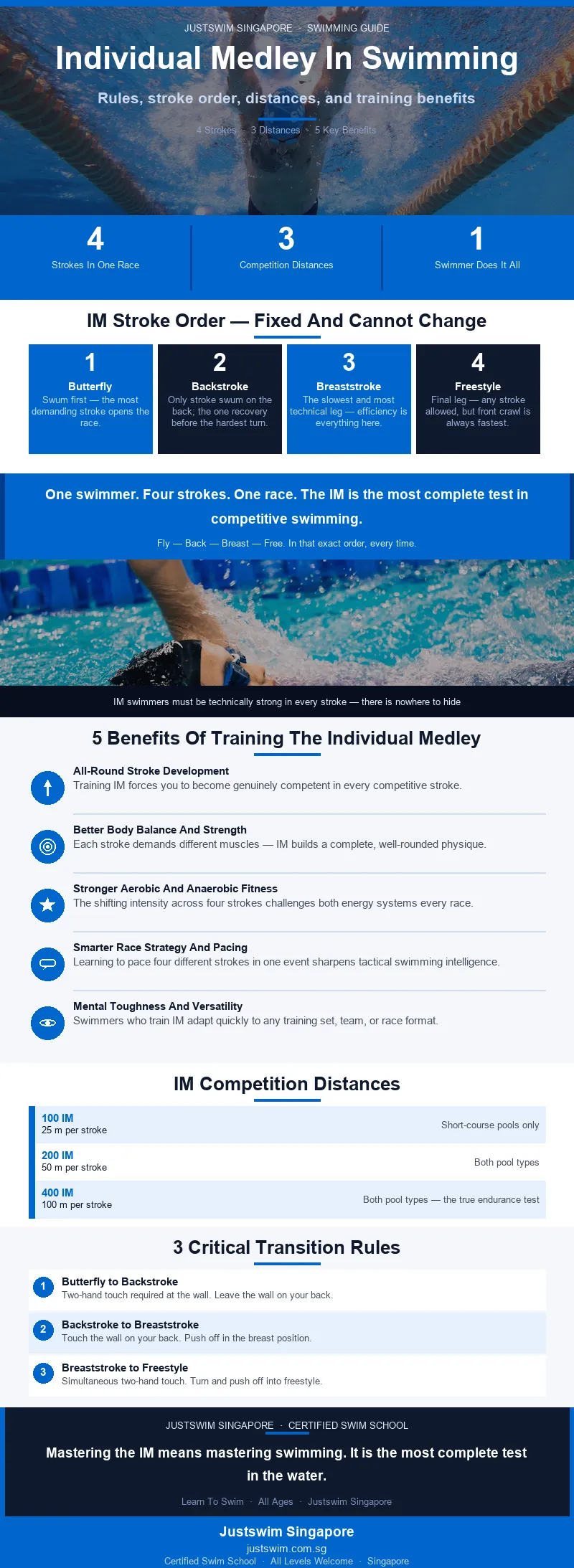
- Butterfly to backstroke: The butterfly leg must end with a two-hand touch. After touching, the swimmer may turn in any manner, but they must leave the wall on their back, with the shoulders past vertical towards the back.
- Backstroke to breaststroke: The swimmer must touch the wall while still on their back. After the touch, a turn is allowed, and the swimmer must push off on the breast to begin the breaststroke leg.
- Breaststroke to freestyle: The breaststroke leg must finish with a simultaneous two-hand touch. After that, the swimmer may turn and push off into freestyle, remaining on the front.
Stroke Order In The Individual Medley

The individual medley in swimming always follows a fixed stroke order set by international swimming rules. This sequence is used in every competition, from local club meets to the Olympic Games, and it never changes. Understanding the order helps swimmers plan their race and avoid confusion during training or competition.
The stroke order in the individual medley is:
- Butterfly – Swum first while the swimmer is still fresh, as it is the most physically demanding stroke and requires strong coordination and power.
- Backstroke – Swum second, allowing a natural transition from a face-down position to swimming on the back while maintaining rhythm and control.
- Breaststroke – Swum third and often the slowest leg, making it a crucial point in the race where strong technique can make a big difference.
- Freestyle – Swum last, using front crawl, which allows swimmers to finish the race at maximum speed.
This order is designed to create smooth transitions between strokes and to balance energy demands across the race. It also ensures fairness by preventing swimmers from starting or ending with a stroke that could provide an advantage.
It is important not to confuse this with the medley relay, which uses a different order:
- Medley relay order: backstroke, breaststroke, butterfly, freestyle
The relay starts with backstroke because the swimmer begins in the water, unlike other strokes that start from the blocks. Keeping these two formats separate helps beginners understand competition rules more clearly.
Distances In The Individual Medley

Individual medley races are offered in several standard distances, depending on the pool length and competition level. Each distance is divided equally among the four strokes, so swimmers always complete the same amount of each stroke within the race.
The most common individual medley distances are:
- 100 Individual Medley (100 IM)
- Typically swam in short-course pools (25 metres or 25 yards).
- Consists of 25 metres or yards of each stroke.
- Focuses on speed, quick transitions, and sharp turns.
- 200 Individual Medley (200 IM)
- Swum in both short-course and long-course (50-metre) pools.
- Includes 50 metres or yards of each stroke.
- Requires a balance of speed, endurance, and smart pacing.
- Common at age-group, club, and elite competitions, including the Olympics.
- 400 Individual Medley (400 IM)
- Swum in both short-course and long-course pools.
- Includes 100 metres or yards of each stroke.
- Emphasises endurance, efficient technique, and strong mental focus.
- Often considered one of the toughest events in competitive swimming.
As the distance increases, pacing becomes more important. Shorter IM races reward explosive speed and clean turns, while longer races require controlled effort and efficient technique across all four strokes. Understanding these differences helps swimmers and parents choose the right goals and training approach.
Individual Medley In Swimming For Beginners: How To Get Started

Starting the individual medley in swimming can feel challenging at first, especially for adults who are new to the sport or parents supporting their children’s progress. The key is to take a structured, step-by-step approach that builds confidence, technique, and endurance over time.
By focusing on strong foundations rather than rushing into full races, beginners can enjoy learning the IM while developing safe and effective swimming habits.
Get Comfortable With All Four Strokes
Before attempting full individual medley sets, beginners should be able to swim butterfly, backstroke, breaststroke, and freestyle with basic control and confidence.
This does not mean perfect technique, but swimmers should be able to complete short distances of each stroke without stopping or panicking. Breathing comfortably, maintaining a stable body position, and understanding the main movements of each stroke are essential at this stage.
Spending time on individual strokes allows swimmers to identify weaker areas early. For many beginners, butterfly and breaststroke require extra patience and practice. Working on these strokes separately helps prevent frustration and makes the transition into IM training much smoother.
Learn The Stroke Order And Transitions On Land
Understanding the stroke order and how transitions work is just as important as swimming the strokes themselves.
Practising the IM sequence on land can help beginners visualise the race and reduce confusion in the water. Simple actions like mimicking arm movements, rehearsing turns, or walking through the stroke order can make a big difference.
In shallow water, swimmers can also practise touches and push-offs slowly, focusing on body position rather than speed. This approach builds confidence and helps swimmers remember what comes next, especially during early IM attempts when nerves can affect concentration.
Start With Short, Simple IM Sets

Beginners should start with short, manageable IM sets to experience the stroke order without becoming overly tired.
A common starting point is swimming 25 metres of each stroke separately, with rest in between. Another option is combining drills with short swims, such as a drill for butterfly followed by an easy freestyle length.
These short sets allow swimmers to focus on technique and transitions rather than endurance. Over time, the strokes can be linked together gradually, helping beginners feel comfortable with the flow of the individual medley.
Focus On Good Turns, Not Just Speed
Legal and efficient turns are a major part of the individual medley and should be prioritised early on. Many disqualifications occur at the wall due to incorrect touches or body positions during transitions.
Practising two-hand touches for butterfly and breaststroke, as well as finishing backstroke on the back, helps build reliable habits.
Good turns also save energy and time. Learning how to approach the wall under control, execute a clean turn, and push off in the correct position allows swimmers to maintain rhythm throughout the race. Speed can always be added later once technique is consistent.
Build Up To 200 Im (And Beyond)
Once swimmers feel comfortable completing a 100 IM, they can begin working towards longer distances like the 200 IM and eventually the 400 IM.
Progression should be gradual, increasing distance or reducing rest rather than doing both at once. Adding controlled IM repeats and longer stroke-specific sets helps build endurance safely.
Working with a coach is highly recommended at this stage. A coach can tailor training sessions, correct technique issues, and ensure that swimmers are progressing at a suitable pace.
With time, patience, and structured guidance, beginners can confidently take on longer individual medley races and enjoy continued improvement in their overall swimming ability.
5 Benefits Of Training For The Individual Medley In Swimming

Training for the individual medley in swimming offers clear advantages, even for swimmers who do not regularly compete in IM races.
By working on all four strokes within the same session, swimmers develop a broader skill set that carries over into every aspect of swimming. For adults learning to swim and children building strong foundations, IM training encourages steady progression, better technique, and greater confidence in the water.
1. All-Round Stroke Development
Individual medley training requires swimmers to practise butterfly, backstroke, breaststroke, and freestyle consistently, rather than relying on a single preferred stroke.
This approach highlights technical weaknesses quickly and encourages swimmers to correct them early. Over time, swimmers develop cleaner technique, better timing, and improved coordination across all strokes.
For beginners, this balanced exposure prevents early specialisation and builds a strong technical base. For more experienced swimmers, refining weaker strokes often leads to noticeable improvements in overall performance, even in single-stroke events.
2. Better Body Balance And Strength
Each swimming stroke uses the body in a different way, engaging various muscle groups and movement patterns.
Training across all four strokes promotes balanced muscular development, helping swimmers build strength evenly through the shoulders, core, hips, and legs. This balance reduces strain on specific joints and lowers the risk of overuse injuries.
For adults and children alike, this full-body engagement supports healthier long-term swimming development. A well-balanced swimmer is more efficient in the water and better equipped to handle increased training loads safely.
3. Stronger Aerobic And Anaerobic Fitness

Individual medley workouts naturally combine endurance and speed demands. Longer IM sets build aerobic capacity, improving heart and lung function and allowing swimmers to maintain technique over extended distances.
Shorter, faster IM sets target anaerobic fitness, helping swimmers develop power and recover more quickly between efforts.
This combination improves overall cardiovascular fitness and translates well into other races. Many swimmers find that regular IM training boosts their performance in freestyle and stroke events by increasing stamina and speed control.
4. Smarter Race Strategy And Pacing
Racing the individual medley teaches swimmers how to manage energy across multiple strokes. Each leg of the race requires a different approach, and swimmers learn to balance effort based on their strengths and weaknesses. Understanding when to push harder and when to conserve energy becomes a valuable skill.
This awareness carries over into all forms of racing. Swimmers who train IM often develop better pacing habits, avoid going out too fast, and finish races more strongly, which is especially beneficial in longer events.
5. Mental Toughness And Versatility
The individual medley challenges swimmers mentally as much as it does physically. Switching strokes mid-race demands focus, adaptability, and the ability to stay calm under fatigue. Learning to manage these challenges builds mental resilience and confidence.
Over time, swimmers become more versatile and comfortable in a wide range of race situations. This mental strength not only improves competitive performance but also helps swimmers feel more capable and confident in the water, regardless of the event or training environment.
Conclusion About Individual Medley In Swimming
The individual medley in swimming is a single race that combines butterfly, backstroke, breaststroke, and freestyle into one complete test of skill.
With a fixed stroke order, clear rules for each leg and transition, and standard distances such as the 100, 200, and 400 IM, it rewards swimmers who are balanced, disciplined, and adaptable.
Training for the IM improves technique across all strokes, builds endurance, and sharpens race awareness—making it one of the best ways to level up overall swimming ability.
If you or your child are looking to start swimming or progress with confidence, consider JustSwim Singapore. Established in 2020 by experienced competitive swimmers, triathletes, and lifesavers, JustSwim specialises in private swimming lessons with patient, dedicated coaches and customised lesson plans for all ages.
Contact JustSwim Singapore today to begin your swimming journey with expert guidance.
Frequently Asked Questions About Individual Medley In Swimming
How Often Should Swimmers Include Individual Medley Sets In Training?
Most swimmers benefit from including individual medley sets one to three times per week, depending on their age, experience, and training goals.
For beginners, shorter and less frequent IM sets help build familiarity with stroke order and transitions without causing excessive fatigue. More experienced swimmers can use IM sets regularly to maintain stroke balance, improve endurance, and sharpen race skills.
Can Adults Learn The Individual Medley Even If They Start Swimming Late?
Yes, adults can learn the individual medley even if they start swimming later in life. The key is progressing gradually, focusing first on becoming comfortable with each stroke before combining them into IM sets.
With patient coaching and structured lessons, adults can build confidence, technique, and endurance at a pace that suits their fitness level.
Are Individual Medley Rules The Same In Short-Course And Long-Course Pools?
The core rules of the individual medley are the same in both short-course and long-course pools, including stroke order and stroke-specific requirements.
The main difference lies in pool length, which affects the number of turns and overall race rhythm. Short-course races involve more turns, while long-course races demand greater sustained endurance.
Does Individual Medley In Swimming Require Equal Skill In All Strokes?
Individual medley in swimming does not require swimmers to be equally strong in all four strokes, but a basic level of competence in each is essential.
Stronger strokes can help make up time, but weaknesses—especially in breaststroke—can significantly impact overall performance. Consistent training across all strokes helps reduce gaps and improve race balance.
Is Individual Medley In Swimming Harder Than Single-Stroke Events?
Many swimmers consider the individual medley harder than single-stroke events because it combines four techniques, multiple turns, and complex pacing.
Managing fatigue while switching strokes requires both physical endurance and mental focus. However, this challenge is also what makes the individual medley so effective for developing well-rounded swimmers.


