

A medley relay is one of the most exciting races in swimming because it combines speed, teamwork, and four different strokes into one event.
If you’ve ever wondered what a medley relay is in swimming, this beginner-friendly guide will break it down in simple terms. In a medley relay, four swimmers form a team, and each swimmer races using a different stroke in a set order.
The result is a fast-paced, high-energy race that looks complicated—but is actually easy to understand once you know the basics. In this guide, you’ll learn how a medley relay works, the stroke order, basic rules, and common beginner mistakes to avoid.
What Is A Medley Relay In Swimming?

A medley relay is a team swimming race made up of four swimmers, with each person swimming a different stroke over an equal distance.
Together, the four legs form one complete race, and the team’s final time is the combined effort of all swimmers. This format makes the medley relay unique because it tests a range of swimming skills rather than focusing on just one stroke.
In a standard medley relay, the strokes are swum in a fixed order: backstroke, breaststroke, butterfly, and freestyle. Each swimmer specialises in one stroke, allowing the team to play to individual strengths.
This is why medley relays are often seen as true team events—success depends on everyone performing their role well, not just one fast swimmer.
The medley relay is often confused with a freestyle relay, but there is a key difference. In a freestyle relay, all swimmers usually swim front crawl, which is the fastest stroke.
In a medley relay, each swimmer must use a different stroke, and the order cannot be changed. This added structure introduces more rules, more strategy, and a greater focus on technique.
How Does A Medley Relay Work?

A medley relay follows a clear sequence from start to finish, with each swimmer completing their part before the next teammate takes over.
Understanding how the race flows helps beginners follow what is happening in the pool and explains why teamwork and timing are just as important as swimming speed. From the opening start to the final touch, every phase of the relay has its own rules and purpose.
Four Swimmers Form One Team
Each medley relay team is made up of four swimmers, and every swimmer is assigned one specific stroke. These strokes are backstroke, breaststroke, butterfly, and freestyle, and each swimmer covers the same distance, usually one quarter of the total race length.
Teams are often formed based on individual strengths, so a swimmer who is technically strong in breaststroke, for example, will usually take that leg of the relay.
Teamwork plays a major role in a medley relay. Even if one swimmer is very fast, the overall result depends on how well the team works together, including smooth exchanges and consistent performances from all four swimmers.
For adults and children learning to swim, medley relays highlight the value of cooperation, communication, and trust between teammates.
The First Swimmer Starts The Race

The first swimmer in a medley relay always swims backstroke, and this makes the start look different from most other races. Backstroke starts in the water, with the swimmer holding the wall or starting grips and pushing off on the starting signal. This is why backstroke must go first in a medley relay.
Because the race starts in the water rather than from the starting blocks, the opening leg requires good body position and a strong push-off.
A clean start helps the team build early momentum and sets the tone for the rest of the relay. This difference in starting style often stands out to beginners watching a medley relay for the first time.
The Next Swimmer Can’t Leave Early
After the first leg, the remaining swimmers start from the starting blocks, but they must time their take-off carefully. The outgoing swimmer is only allowed to leave the block after the incoming swimmer touches the wall. If the feet leave the block too early, the entire team is disqualified.
This moment is called a relay exchange, and it is one of the most important parts of the race. Good exchanges can save valuable time, while poor timing can cost the team the race. For beginners, practising safe and well-timed exchanges is essential to avoid mistakes and build confidence during relay events.
Each Swimmer Must Finish Their Leg Correctly
Every swimmer in a medley relay must finish their leg according to the rules of their assigned stroke. This includes legal turns and proper finishes at the wall before the next swimmer can start. The finish of one leg becomes the starting signal for the next, making accuracy just as important as speed.
If a swimmer fails to touch the wall correctly or breaks a stroke rule at the finish, the team can be disqualified. This is why good technique and attention to detail matter in medley relays. For learners and parents, this reinforces the importance of mastering correct stroke fundamentals during swimming lessons.
Medley Relay Stroke Order (And Why It’s Always The Same)
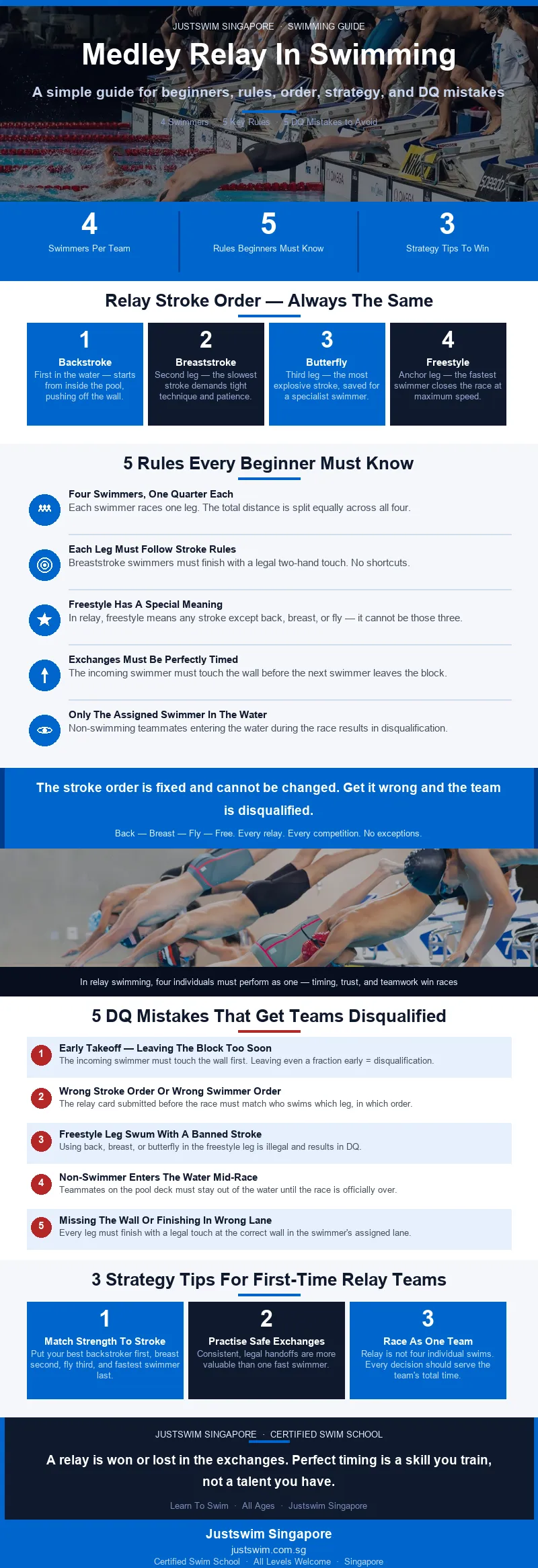
One of the most important things to understand about a medley relay is that the stroke order is fixed and cannot be changed. In every official competition, the strokes must be swum in this exact sequence:
1) Backstroke → 2) Breaststroke → 3) Butterfly → 4) Freestyle
This order is a rule of the event, set by governing bodies such as World Aquatics (formerly FINA), and all teams must follow it. Changing the order, even by mistake, results in disqualification.
The main reason backstroke goes first is safety and practicality. Backstroke is the only stroke that starts in the water, so it must begin the race. Once the backstroke swimmer finishes, the remaining swimmers can safely start from the starting blocks. This keeps the race fair and consistent across all competitions.
Breaststroke comes next because it has the most technically demanding rules and is often the slowest stroke. Placing it second helps balance the race and allows teams to rely on strong technique rather than pure speed.
Butterfly follows as the third leg, bringing power and pace back into the race, before freestyle closes the relay. Freestyle is last because it allows the fastest swimmers to finish strongly, creating exciting and competitive endings.
Quick Note: Medley Relay vs Individual Medley (IM)
Many beginners confuse the medley relay with the individual medley (IM), but the stroke order is different. In an individual medley, a single swimmer completes all four strokes in this sequence:
Butterfly → Backstroke → Breaststroke → Freestyle
If you find yourself thinking, “Doesn’t medley start with butterfly?” you are likely thinking of the IM, not the relay. Remember, in a medley relay, the order always starts with backstroke, because each swimmer only swims one stroke and the race begins in the water.
5 Basic Medley Relay Rules Beginners Should Know

Medley relays may look fast and exciting, but they are also governed by clear rules that every beginner should understand. Knowing these basics helps swimmers avoid unnecessary disqualifications and makes swim meets much easier to follow for parents and adult learners.
1. There are four swimmers, and each swims one quarter of the total distance: A medley relay team always consists of four swimmers, with each person completing an equal part of the race. The strokes must be swum in this fixed order: backstroke, breaststroke, butterfly, then freestyle. This order is set by official competition rules and cannot be changed.
2. Each leg must follow the rules of that stroke, including the correct finish: Every swimmer must swim their assigned stroke according to its specific rules. This includes legal turns and, most importantly, a correct finish at the wall before the next swimmer can start. Transitions such as backstroke to breaststroke and breaststroke to butterfly are closely watched by officials.
3. “Freestyle” in a medley relay has a special meaning: In medley relay events, freestyle does not mean any stroke is allowed. It must be a stroke other than backstroke, breaststroke, or butterfly, which is why front crawl is almost always used. Swimming one of the other three strokes on the freestyle leg can lead to disqualification.
4. Relay exchanges must be perfectly timed: The outgoing swimmer must stay on the starting block until the incoming swimmer touches the wall. If the feet leave the block too early, the entire team is disqualified. Practising exchanges is essential, especially for beginner teams.
5. Only the assigned swimmer should be in the water during the race: During the race, only the swimmer currently swimming their leg should be in the pool. If another team member enters the water before the race is finished, the team may be disqualified. This rule helps keep races fair and the pool safe for all competitors.
Common Beginner Mistakes (That Can Get A Team Disqualified)

Medley relays are exciting to watch, but they are also one of the easiest events for beginners to get disqualified in.
Many disqualifications happen not because swimmers are slow, but because of small technical errors or misunderstandings of relay rules. Knowing these common mistakes helps first-time teams race with more confidence and fewer surprises.
Leaving The Block Too Early (Early Takeoff / Exchange Violation)
An early takeoff happens when the outgoing swimmer’s feet leave the starting block before the incoming swimmer touches the wall.
This often occurs because swimmers are eager to gain an advantage or misjudge the timing of their teammate’s finish. Even a very small early movement can result in disqualification.
A simple way to improve takeover timing is to practise watching the incoming swimmer’s hands, not just listening for the splash or anticipating the touch.
Many teams focus on safe exchanges first, then gradually work on speed as confidence improves. For beginners, a slightly slower but legal exchange is always better than a fast one that leads to disqualification.
Swimming The Wrong Relay Order Or The Wrong Swimmer Order On The Relay Card
The medley relay has a fixed stroke order: backstroke, breaststroke, butterfly, then freestyle. Swimming the correct stroke but in the wrong position automatically disqualifies the team. This can happen easily at busy swim meets, especially when swimmers or parents are unfamiliar with relay formats.
Another common issue is a mismatch between the swimmers in the pool and the order listed on the relay card. To avoid this, teams should double-check the relay card before the race and confirm who is swimming each leg. Taking a minute to review the lineup can prevent a costly mistake.
Doing The “Freestyle” Leg With A Non-Allowed Stroke (Back/Breast/Fly)

In a medley relay, the freestyle leg does not allow backstroke, breaststroke, or butterfly. The final swimmer must use a stroke other than those three, which is why front crawl is almost always chosen. Beginners sometimes assume freestyle means any stroke, leading to confusion and disqualification.
This mistake often happens with younger swimmers or adults new to competitive swimming. Coaches and parents can help by clearly explaining the special freestyle rule before the race. Reinforcing this detail during lessons builds good habits and avoids unnecessary penalties.
A Non-Swimming Teammate Enters The Water At The Wrong Time
Only the swimmer currently racing their leg should be in the pool during a medley relay. Teammates jumping into the water early to celebrate, warm down, or support a swimmer can result in disqualification. This rule exists to keep the pool safe and fair for all competitors.
To prevent this, swimmers should be reminded to stay behind the starting blocks or designated waiting areas until the race is completely finished. Clear communication from coaches and parents helps beginners understand proper meet behaviour.
Missing The Wall / No Touch Or Finishing In The Wrong Lane
In fast-paced relay races, swimmers may misjudge their finish and fail to touch the wall properly, especially when rushing an exchange. Missing the wall or making an incomplete touch is grounds for disqualification. Lane confusion can also occur if a swimmer surfaces too early or drifts during a finish.
Good habits make a big difference here. Swimmers should practise strong, deliberate wall touches and always finish in the centre of their lane. Slowing down slightly at the wall to ensure a clean touch is far better than risking a disqualification at the end of the race.
3 Simple Strategy Tips For First-Time Medley Relay Teams

For teams new to medley relays, a little planning goes a long way. These simple strategy tips focus on making the race smoother, more confident, and more enjoyable for swimmers and parents watching from the stands.
1. Choose swimmers based on stroke strength, not just speed: Each stroke has different technical demands, so swimmers should be assigned to the stroke they perform most confidently.
A technically strong breaststroker or backstroker can contribute more to the team than a faster swimmer who is uncomfortable with that stroke. Matching swimmers to their strengths leads to smoother races and more reliable performances.
2. Practise safe and consistent relay exchanges: Relay takeovers are a common source of errors for beginner teams. Focus first on legal, well-timed exchanges by watching the incoming swimmer touch the wall before leaving the block.
Once exchanges become consistent, teams can gradually work on improving speed without risking disqualification.
3. Race as one team, not four individual swimmers: A medley relay is a shared effort, and every leg matters. Swimmers should support each other, stay focused during all exchanges, and treat clean takeovers as important successes.
This team-based approach builds confidence, improves results, and makes relays more enjoyable for swimmers and parents alike.
Conclusion About Medley Relay In Swimming
Now that you know what a medley relay is in swimming, it becomes much easier to follow and enjoy this fast-paced team event. A medley relay is a four-swimmer race where each person swims a different stroke in a fixed order: backstroke, breaststroke, butterfly, then freestyle.
The biggest things to remember are simple—stick to the correct stroke order, make clean wall touches, and never leave the block early during exchanges. With a little practice, especially on takeovers, medley relays become exciting rather than confusing.
If you or your child are learning to swim, understanding relays and stroke technique starts with strong fundamentals.
JustSwim Singapore, established in 2020 by experienced coaches from competitive swimming, triathlon, and lifesaving backgrounds, specialises in private swimming lessons for both adults and children.
Our patient coaches focus on water safety, correct technique, steady progression, and enjoyment, using a unique teaching approach and customised lesson plans to suit every age and ability.
To build confidence in the pool and get your strokes right, contact JustSwim Singapore today to find the right swimming lessons for you or your child.
Frequently Asked Questions About Medley Relay In Swimming
Do Medley Relay Swimmers Need To Be Equally Fast?
No, medley relay swimmers do not need to be equally fast. Teams are usually formed based on stroke strengths, not identical speed, because each swimmer specialises in a different stroke. A technically strong breaststroker, for example, can be just as valuable as a very fast freestyler in helping the team perform well.
How Are Relay Takeovers Judged In Medley Relay Races?
Relay takeovers are judged by officials and electronic timing systems that monitor the moment the incoming swimmer touches the wall and the outgoing swimmer leaves the block.
If the outgoing swimmer’s feet leave the starting platform before the incoming swimmer touches, the team is disqualified. This is why practising takeovers is essential, especially for beginner teams.
Can Beginners Take Part In A Medley Relay In Swimming?
Yes, beginners can take part in a medley relay as long as they can swim their assigned stroke legally and understand basic relay rules.
Many schools and clubs use medley relays to introduce teamwork and build confidence in a fun, supportive setting. It is often one of the first team events beginners experience in swimming.
Are Medley Relay Rules The Same Across All Swim Competitions?
The core rules of the medley relay are largely the same across competitions, including stroke order and exchange requirements. However, minor differences may exist depending on the governing body, age group, or local meet rules. It is always a good idea to check the specific competition guidelines before racing.
Is The Medley Relay In Swimming Suitable For Non-Competitive Swimmers?
Yes, the medley relay is suitable for non-competitive swimmers and is often used in training sessions and swimming lessons.
It helps swimmers practise different strokes, improve coordination, and enjoy the social aspect of swimming. For many learners, medley relays make swimming more engaging without the pressure of individual racing.


